Spectrum Chart

Spectrum Chart
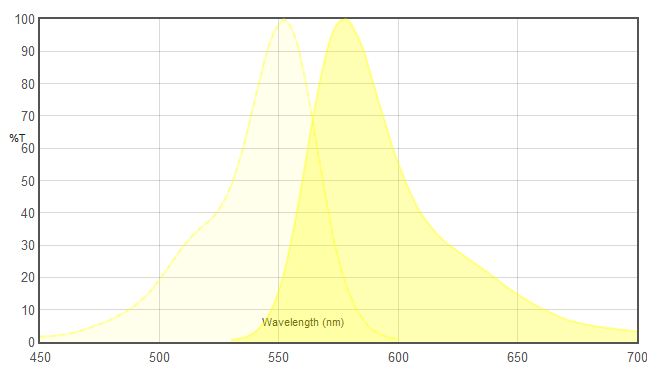
| Excitation (㎚) | Emission (㎚) |
| 555 | 580 |
| Filter Model No. | Excitation filter (㎚) | Dichroic mirror (㎚) | Emission filter (㎚) | Remarks |
| JNO-G(B) | 540/25 (527.5~552.5) |
565 (LP) | 605/55 (577.5~632.5) |
Narrow Excitation band, Bandpass Emission |
| 49004 | 545/25 (532.5~557.5) |
565 (LP) | 605/70 570~640) |
Narrow Excitation band, Bandpass Emission |
| 49305 | 546/22 (535~557) |
565 (LP) | 590/33 (573.5~606.5) |
Narrow Excitation band, Bandpass Emission |
| Filter Model No. | Excitation filter (㎚) | Dichroic mirror (㎚) | Emission filter (㎚) | Remarks |
| 49908 | 532/10 (527~537) |
532 (LP) | 590/50 (565~615) |
For use with laser between 529~535㎚
Very Narrow Excitation band, |
| 49909 | 561/10 (556~566) |
561 (LP) | 600/50 (575~625) |
For use with laser between 557~563㎚
Narrow Excitation band, |
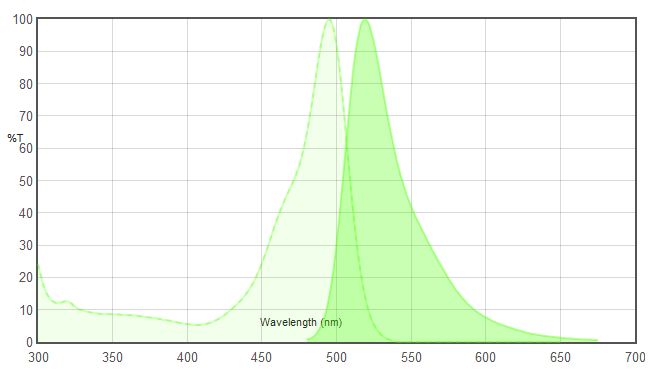
| Excitation (㎚) | Emission (㎚) |
| 490 | 525 |
| Filter Model No. | Excitation filter (㎚) | Dichroic mirror (㎚) | Emission filter (㎚) | Remarks |
| JNO-B(B) | 480/30 (465~495) |
505 (LP) | 535/40 (515~555) |
Medium Excitation band, Bandpass Emission |
| 49002 | 470/40 (450~490) |
495 (LP) | 525/50 (500~550) |
Wide Excitation band, Bandpass Emission |
| 49011 | 480/40 (460~500) |
510 (LP) | 535/50 (510~560) |
Wide Excitation band, Bandpass Emission |
| Filter Model No. | Excitation filter (㎚) | Dichroic mirror (㎚) | Emission filter (㎚) | Remarks |
| 49904 | 488/10 (483~493) |
488 (LP) | 525/50 (500~550) |
For use with laser between 485~491㎚
Very Narrow Excitation band, |
Fluorescein isothiocyanate (FITC) is a derivative of fluorescein used in wide-ranging applications including flow cytometry. FITC is the original fluoresce in molecule functionalized with an isothiocyanate reactive group (-N=C=S), replacing a hydrogen atom on the bottom ring of the structure. This derivative is reactive towards nucleophiles including amine and sulfhydryl groups on proteins.
A succinimidyl-ester functional group attached to the fluorescein core, creating “NHS-fluorescein”, forms another common amine reactive derivative that has much greater specificity toward primary amines in the presence of other nucleophiles.
FITC has excitation and emission spectrum peak wavelengths of approximately 495 ㎚ /519 ㎚. Like most fluorochromes, it is prone to photobleaching. Because of the problem with photobleaching, derivatives of fluorescein such as Alexa 488 and DyLight 488 have been tailored for various chemical and biological applications where greater photostability, higher fluorescence intensity, or different attachment groups are needed.
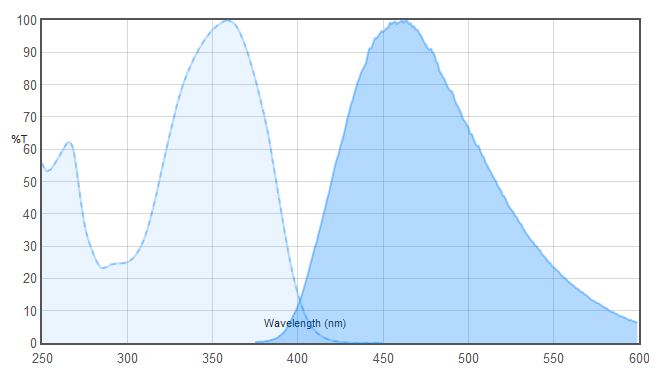
| Excitation (㎚) | Emission (㎚) |
| 359 | 461 |
| Filter Model No. | Excitation filter (㎚) | Dichroic mirror (㎚) | Emission filter (㎚) | Remarks |
| JNO-U(B) | 375/28 (361-389) | 415 (LP) | 460/50 (435-485) | Narrow Excitation band, Bandpass Emission |
| 49000 | 350/50 (325-375) | 400 (LP) | 460/50 (435-485) | Wide Excitation band, Bandpass Emission |
| 49028 | 395/25 (382.5-407.5) | 425 (LP) | 460/50 (435-485) | For 395㎚ light sources Narrow Excitation band, Bandpass Emission |
DAPI (4′,6-diamidino-2-phenylindole) is a fluorescent stain that binds strongly to A-T rich regions in DNA. It is used extensively in fluorescence microscopy. As DAPI can pass through an intact cell membrane, it can be used to stain both live and fixed cells, though it passes through the membrane less efficiently in live cells and therefore the effectiveness of the stain is lower.
DAPI (4 ‘, 6-diamidino-2-phenylindole)는 DNA의 A-T가 풍부한 부위에 강하게 결합하는 형광 염료입니다. 그것은 형광 현미경에서 광범위하게 사용됩니다. DAPI는 손상되지 않은 세포막을 통과 할 수 있기 때문에 살아있는 세포에서 덜 효율적으로 막을 통과하기 때문에 살아있는 세포와 고정 된 세포를 모두 염색하는 데 사용할 수 있으므로 얼룩 효과는 낮습니다.